

 By Dr. Rita Khanna
Human eyes are a wonderful creation of nature, and these need care and attention. As years go by, the muscles around the eyes lose their tone. Eyesight becomes weak after the muscles around the eyes lose their elasticity and become rigid, thereby reducing the power to focus different distances. In addition, tension around the eyes affects the brain, causing stress and anxiety. There is a deep correlation between the eyes and the mind. It is said that vision occupies 40 percent of the brain’s capacity. Therefore, when we close our eyes, relaxation is induced in the brain. Eyesight is dramatically improved when the muscles of the eyes are relaxed.
OUR EYES
 Our eyeball comprises three layers—sclerotic or the outer layer, choroid or the middle layer, and retina or the inner layer. The sclerotic layer is white and opalescent, with a transparent center called the cornea. Light is transmitted to the eye through the cornea. The choroid layer is called the iris, with the pupil in its center. Directly behind the iris lies the crystalline lens, which focuses light passing through it upon the retina. Around this lens lie the ciliary muscles that control its contraction and expansion. The retina, or the inner layer, is like a screen that receives the projected images of external objects.
You see something when the pupil lets light pass through the cornea onto the crystalline lens. Brightness is controlled by the pupil through contraction or dilation. These rays converge upon the retina via the convex crystalline lens, forming an inverse image. The optic nerve then transmits this image to the brain, producing the final sense of vision.
THREE MOST COMMON DEFECTS OF THE EYES
 Sight can be adversely affected by various things, ranging from malnutrition to a recurring cough and cold. Perhaps the three most common defects of eyesight are myopia (short-sightedness), hypermetropia (long-sightedness) and presbyopia (failing eyesight due to age). While in myopia, the image is formed short of the retina, in hypermetropia or presbyopia, the image is formed beyond the retina. These conditions are the result of faulty eye muscle action or imperfect accommodation. Generally, such disorders are corrected by introducing artificial lenses, such as spectacles. These lenses bring the image onto the retina; however, this treats the symptom, not the disorder of imperfect accommodation.
YOGIC MANAGEMENT
Yoga offers a host of corrective measures for defective eyesight. Simple Yogic exercises can keep your eyes free from impaired vision and ugly spectacles. Yogic eye exercises strengthen the muscles of the eyes, and thus, help in curing many ailments of the eyes. Vision could be improved with eye exercises like palming, eyeball rotations, and gaze shifting. To improve the eyesight, follow the methods described here:
YOGIC EXERCISES FOR EYE MUSCLES
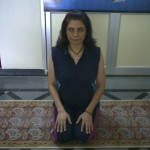
Sit in Padmasana, Vajrasna, Sukhasana, Swastikasana or Siddhasana, or on a chair; but your back and neck should remain straight. Before beginning the eye exercises, just relax the eyes by closing them for a moment, or assume the corpse pose, to relax all the body parts. Do the following eye exercises regularly to prevent and cure any disorder of the eyes.
TECHNIQUE
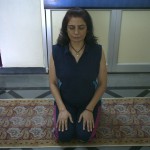 1. Move the eyeballs up and look at the space between the eyebrow-center; then, lower the eyeballs and look at the tip of the nose. Do it effortlessly, in a slow motion, allowing the gaze to go up and down to the maximum level. Don’t move the head. See only by moving the eyeballs. Do it for eight to ten times. The cornea will be seen moving up and down. Then, take rest by closing the eyes for some moments.
2. Move the eyeballs horizontally parallel to the floor in a straight line from right to left, and from the left side to right side, allowing them to go as far as they can. Do it for eight to ten times. Then, close the eyes for some moments and give rest to the eyes.
3. Now, move the eyeballs on left upper side and then right lower side. After that, move it on the right lower and left upper side, in an oblique direction. Do it for eight to ten times. Then, take rest by closing the eyes for some time.
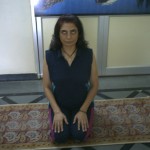 4. Now, reverse the sequence. Move the eye balls on the right upper and then left lower side. After that, move it on the left lower side, and then right upper side, in an oblique direction for eight to ten times. Then, close the eyes and take rest for some time.
5. Now, move the eyeballs from right to left and from left to right, in an upper semi circle. Do it for eight to ten times. Then, by closing the eyes take rest.
6. Now, move the eyeballs from left to right and from right to left, in a lower semi circle for eight to ten times. Then, take rest by closing the eyes for some time.
7. Now, rotate the eyes clockwise, and then anticlockwise, in a circular motion. Do it for four to six times on both the sides. After that, give rest to the eyes.
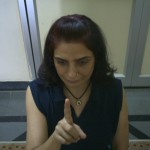
 8. Now, stretch the right arm forward and keep it parallel to the floor. Keep the index finger vertically pointing up, and fix the eyes on the nail of the finger, or just beyond the nail. Now, see the finger with both eyes. Gradually, bring the finger towards the nose, and keep it there for some time; then take it away from it. You can do like this four to five times. While focusing your attention at the finger, you will find you are not seeing one finger, but two. Hence, in this exercise, eyes become eccentric. One finger will be the main finger, which is real, and the other will be an optical illusion.
9. In the end, blink the eyes eight to ten times. Now, rub the palms and create heat, and do palming on the eyes, repeating three times. The warm Prana current flowing from the palms relieves the tension, and strain, around the eye muscles.
 NOTE
NOTE
• The body must be relaxed, and the head should not move, when the eye exercises are performed. Except for the eyes, all parts of the body should be in a relaxed position.
• Give rest to the eyes, by keeping them closed for 10 to 12 seconds between each process.
• Do not wear spectacles while doing the exercises.
SOME BRIEF EXERCISES FOR THE EYES
• Bounce a ball in a v-shape, from one hand to the other, and follow the movement of the ball with the eyes.
• Elephant swing: From a standing position, bend forward with your feet – 1 foot apart. Bend the knees, with hands together; hang them down, and swing like the trunk of an elephant, looking down at the floor.
• Take a sculpture/picture, or any other object, and look at it for about 30-45 seconds. Close eyes and visualize the object with the eyes closed and relaxed. Use a different object each day.
• Distance accommodation: Look at a tree for 30 seconds; then look at the palm, all the lines on the palm, for 30 seconds; blink and see (5 times).
• Read in candle light (10 minutes).
NECK EXERCISE
• Sit with the back straight. Turn the tongue inside towards the throat and touch it against the upper palate.
• Bend the head downwards, and press the chin to the chest, then head up looking backwards. Inhale when the head moves upwards, and exhale when the head moves downwards. Do it four to five times.
• Very slowly rotate the head first on the right side, and then on the left side. Inhale deeply when the neck moves on the right side and comes in the line of right shoulder, and exhale when it returns to front side position. Inhale when it moves on the left side, and exhale when it returns to front side gradually. Repeat this exercise eight to ten times; that is, four to five times each side. Now, relax the neck.
 • Thereafter, bring the right ear up to the right shoulder, and then the left ear to the left shoulder. Repeat this exercise eight to ten times, in total; that is, four to five times each side. Now, relax the neck.
• Now, rotate the head and neck from right side. In this – tilt the head first on the right side, then on the back side, then on the left side, and in front last. This would complete one rotation. Repeat four to five times very gently and without any stress. Do it in the reverse direction; also that is; starting it from the left side. Repeat four to five times without hurrying.
• Rub the hands and massage the neck, with warm hands, nicely.
You can do shoulder rotation and arm rotation exercises, also, to remove stress from the shoulders and arms. Do clockwise for eight to ten times, and then anti clockwise for eight to ten times.
DIET
Take fruits and vegetables, which contain more of Vitamin A, in good quantity. All red and yellow colored fruit are recommended.
First thing in the morning – lemon water (lukewarm) with two teaspoons honey.
Breakfast – Have munacca (Dry fruit) (10-15 no.) and figs (2-4 no.); they should be soaked overnight in water in a glass container after being cleaned thoroughly. They should be taken along with the water, in which they were soaked. Chew well. If you are still feeling hungry, then after half an hour gap, take seasonal fruit, such as mangoes, banana, apple, apricot, and papaya – all red and yellow colored fruit. Eating one variety of fruit each time is very beneficial.
Lunch – Chapattis of wheat flour with extra bran + seasonal vegetables (lauki, broccoli, cabbage, carrot, drumsticks, cauliflower, spinach, salad) and curd.
Evening – Carrot juice, vegetable soup, lemon water honey
Dinner – Same as lunch or Dalia (Broken Wheat)
Avoid – Caffeine, nicotine, alcohol, deep fried foods, processed foods, and most chemical preservatives in packaged foods. Also, avoid white sugar and use little salt. Use honey or brown sugar.
 ASANA
ASANA
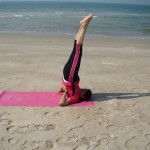
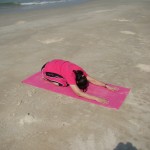
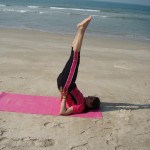
Shirsasana, Sarvangasana, Vipritkarni Mudra – for those who don’t have cervical spondylosis, high myopia, hypertension, or pregnancy. The eyes obtain tremendous power by practicing these Asanas. After doing Shirsasana, don’t sit up or stand up immediately. Take rest in Shashankasana for some time. Other Yoga poses that strengthen eyes include: Bhujangasana, Shavasana, and Surya Namaskara.
PRANAYAMA
Aumkar, Bhramari, Shitali, and Anulom-Vilom – Do Shitali Pranayama with opened eyes. Regular practice of these 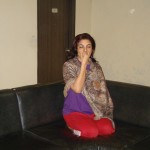 Pranayama perfuses the eyes with plenty of blood flow. Pranayamas should be practiced in the mornings, and evenings, on an empty stomach.
YOGA-NIDRA AND MEDITATION
For better eye care, include deep relaxation (Yoga-nidra) in the practice routine. Practice of Yoga-nidra, and Meditation, gives rest to the eyes and increases their working capacity.
MEDITATION AND VISUALIZATION
Slowly, concentrate your awareness on your eyeball, and create its mental picture. If you are myopic, tell your eyes to contract enough to allow the image to coincide on the retina. If you are long-sighted, tell your eyes to elongate enough to allow the image to coincide on the retina. Supplement your visualization with some catchy affirmation, such as: “My eyes perform better than the best automatic cameras I have ever known.” Practice this visualization; meditate at least for 15-20 minutes twice a day.
PRANA MUDRA FOR INCREASING EYE SIGHT
Touch the tips of the little finger, and ring finger, by the tip of the thumb. Rest two fingers; that is, the index and middle finger should be straight. Perform Prana Mudra for at least 15 to 30 minutes. Practice regularly for better vision.
TRATAKA
Light a candle, and keep it at eye level, at a distance of about two feet. Sit comfortably and gaze at the candle flame, without blinking, for about 2-3 minutes. If eyes begin to water before that, close the eyes. Once the eyes are closed, try to gaze internally at the after-image of the candle flame, at the back of your mind’s eye. Repeat this whole routine one more time.
Then, slowly get up and fill your mouth with water. Keeping this water in your mouth, wash the eyes with tap water. Then spit the water out. This water will be warm as heat gets released from the body. This has to be done twice, or until the water temperature gets normal. This is a must after this particular Kriya.
This routine will help you strengthen and relax the eye muscles. Also, it is used as a practice for developing focus and concentration, and can be used as a prelude to Meditation.
JALA NETI KRIYA (NASAL WASH)
Jala Neti is a simple technique, which involves using a special “neti pot” filled with warm, slightly salted water. The nose cone is inserted into one nostril, and the position of the head, and pot, is adjusted to allow the water to flow out of the other nostril. Whilst the water is flowing through the nasal passages, one breathes through the mouth. (One should do this Kriya under guidance in the beginning). Practice of Jalaneti Kriya gives much benefit to eyesight. It keeps the eyes free from congestion and strain, and improves vision. Its use can be learned from any Yoga instructor. Neti should be practiced in the morning, before Pranayama.
WASHING THE EYES
After attending to the call of nature, wash the eyes in the eye washing glass. Fill the eye washing glass with pure water, and cup the eyes in it. Blink inside the water 15 to 20 times. (In the absence of an eye washing glass, your palm can be cupped for the purpose.) Throw away the water, and refill the glass with some more fresh water, and wash once again. Repeat the same with the other eye. Wash them after watching television, before retiring to bed, as you come home after a long tiring day outdoors, and also after reading for a considerable time at a stretch. Do not watch television unblinkingly.
SUNBATHING THE EYES
Early morning, allow indirect Sunlight into the eyes (closed eye lids). Keep your feet a foot apart, let your arms hang loosely at the sides, and be as relaxed as possible; sway the body gently from side-to-side – like a pendulum, for three to five minutes. Hot Sun at noon should be avoided. At Sunrise, and Sunset, look directly into the Sun for a short period of time; it should be stopped as soon as the Sun causes discomfort.
After the Sun treatment, come to the shade and place a piece of cold wet cloth on the closed eye lids for two minutes / Sprinkle cold water over your eyes, and then dry them with a soft piece of cloth.
BLINKING
• Practice deliberate blinking for five full minutes any time of the day.
• Squeeze gently under the eyes before going to sleep.
• Roll the eyes in the socket clockwise and anti-clockwise.
PALMING
 • Rub both palms together, quickly, for 10 seconds. This friction creates mild heat. Close the eyes, and gently place the left palm over the left eye and right palm over the right eye. Do not apply pressure with the palms, but just let them gently rest. Breathe in and out slowly to release stress. Repeat this 2-3 times.
• Sit comfortably in a chair, in front of a table, and stay relaxed. Close your eyes. Cup your right palm and shield the right eye with it. Cup your left palm and cover the left eye with it. Let the fingers of both hands meet on the forehead. Rest the elbows on the table and keep yourself completely relaxed. Look only at the darkness without opening the eyes. Let your mind also relax for some time. Sit like this for five minutes at a time, at least thrice a day.
AVOID
Bright Sunlight, reading in poor light, or in a lying down position, reading or writing in a moving train, plane, car or bus, watching television for too long, or working at a computer for long hours. These causes stress on the eyes, and contracts the eye muscles, which leads to deteriorating eyesight or pain in the eyes.
SOME MORE SUGGESTIONS
 • For all eye problems, keep the eyes clean. Splash fresh, clean water on the eyes, 10-15 times, at least twice a day.
• Dampen wads of cotton-wool with pure Organic Rose Water and place over closed eyes. Relax for 10 minutes that way. The cooling effect of organic rose water helps cool tired eyes.
• Every four to six months, or minimum once in a year, your eyes should be checked for their visual capacity, even though our eyes are normal. They should be immediately tested if something unexpected happens, so that if there is any change in the vision, the eyes can be immediately treated. It is very important especially for the children.
• In India, the self urine therapy experiment, to wash the eyes, is popular. It increases the working capacity of the eyes and removes stress.
• Constipation also affects our eyes. Therefore, it is essential that bowels get cleaned fully every day. For this, drink plenty of water throughout the day, as constipation or internal dryness can have an adverse effect on the eye. Do practice Yogamudra and Vajrasana (after the meals). Shitali Pranayama, in the morning and evening, is very effective. Periodic use of enema is also helpful.
• Morning and evening walks rejuvenate the eyes, enhancing proper sight.
• Walking barefoot on the grass, in the morning, is very good for the eyes.
• In case you have access to Triphala, put a teaspoonful of Triphala powder in a glass of water, and let it stay overnight. Strain the water and wash the eyes with it.
• Improve your diet; enjoy Sunshine and fresh air. Winter Cherry (Ashwagandha) also helps strengthen vision.
• To improve eyesight, soak seven almonds overnight. Next morning, grind it to a paste, with seven peppers, and mix with water and sugar candy, using the same water in which it was soaked. Take this paste after meals, regularly, for a few months.
• These remedies can help you keep your eyes healthy and beautiful, and can be used by everyone, in general.
Eyes are the pearls of life. Taking care of them is our prime duty. Spare at least half an hour every day for eye care. Change your food habits, do regular eye washing, and other exercises, and you will be benefited by these safe and natural methods. The eyes can be donated after death. Hence, two eyes can give vision to two needy persons who will be able to see the world. Utilize them with the correct eye care program that includes eye exercises, proper diet, and supplementation. Don’t misuse them. Every morning, start the exercises with the determination that YOU ARE GOING TO IMPROVE THE EYESIGHT AND DISCARD THE GLASSES. Have faith and patience.
AUM SHANTI
If you feel inspired by this article, feel free to publish it in your Newsletter or on your Website. Our humble request is to please include the Resource as follows: –
Courtesy: Dr. Rita Khanna’s Yogashaastra Studio.
A popular studio that helps you find natural solutions for complete health.
Mobile: + 919849772485
Ph:-91-40-65173344
Email: yogashaastra@gmail.com
Website: www.yogashaastra.in
Dr. Rita Khanna
Dr. Rita Khanna is a well-known name in the field of Yoga and Naturopathy. She was initiated into this discipline over 25 years ago by world famous Swami Adyatmananda of Sivananda Ashram in Rishikesh (India).
She believes firmly that Yoga is a scientific process, which helps us to lead a healthy and disease-free life. She is also actively involved in practicing alternative medicines like Naturopathy. Over the years, she has been successfully practicing these therapies and providing succour to several chronic and terminally ill patients through Yoga, Diet and Naturopathy. She is also imparting Yoga Teachers Training.
At present, Dr. Rita Khanna is running a Yoga Studio in Secunderabad (Hyderabad, India).
Leave A Comment
You must be logged in to post a comment.